

Easter is one of the most important celebrations in the Italian calendar, and unlike holidays that center on a single dish, the Italian Easter table is built around an entire language of food. Each region has its own version. Each family has its own interpretation. And behind every recipe is a tradition carried forward by the people who made it.
Here’s what you actually need to know.
How the Week is Structured
Palm Sunday traditions follow the Catholic calendar closely, and the cooking reflects it.
- Good Friday is a day of fasting. Fish dishes like baccalà replace meat.
- Holy Saturday is when the real cooking happens: pies are assembled, doughs are prepared, kitchens are at full speed.
- Easter Sunday is the feast. Savory pies, sweet pies, roasted lamb, spring vegetables, and hard-boiled eggs all share the table.
- Pasquetta (Easter Monday) is a more relaxed continuation: leftovers, family, often outdoors.
The Italian Easter Pie Tradition
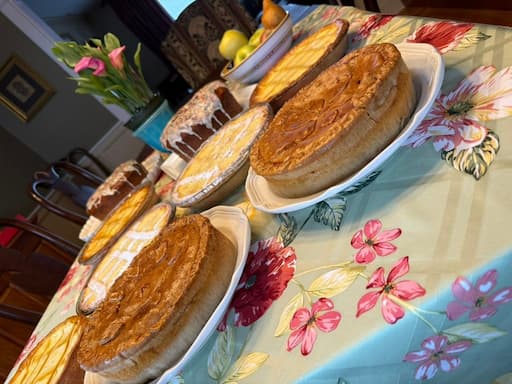
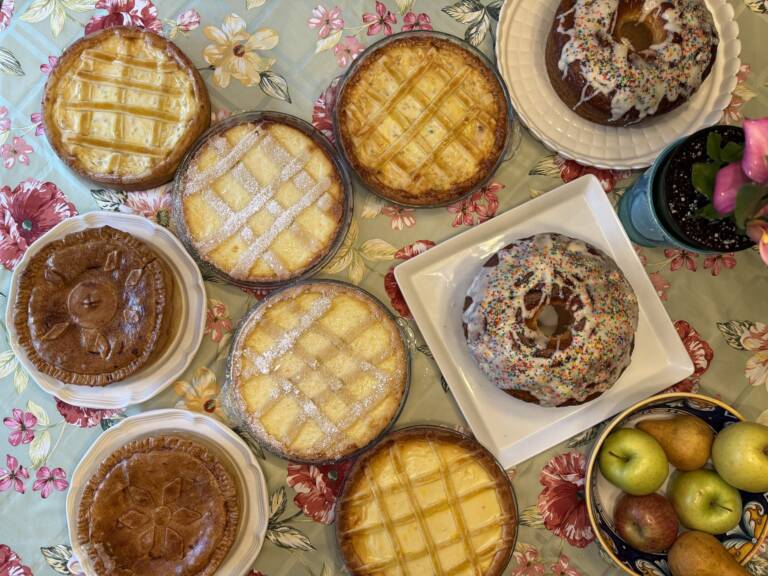
The centerpiece of the Italian Easter table, particularly in Southern Italian and Italian-American households, isn’t one dish. It’s a collection of pies, both savory and sweet, made in the days before Sunday.
Pizza Rustica (Pizzagaina) — Savory
A double-crusted pie filled with cured meats (salami, soppressata, prosciutto), eggs, and cheeses (ricotta, mozzarella, sharp Italian). Dense, rich, and specifically tied to the end of Lent.
It was traditionally the first thing eaten after the Easter Vigil, breaking the fast. Every family’s version is different. Almost none of those differences are written down.
Casatiello Napoletano — Savory and Sweet
A leavened ring-shaped bread from Naples, studded with salami and cheese, with whole eggs baked directly into the surface. The ring shape represents the crown of thorns. The eggs represent resurrection.
Sweet – A bread that feels like celebration itself, rich and symbolic, often prepared with intention and patience.
It’s one of the clearest examples of food functioning as a religious symbol in Italian tradition.
Pastiera Napoletana – Sweet
The most iconic Italian Easter dessert. A short pastry crust filled with cooked wheat berries, ricotta, eggs, sugar, and orange blossom water then finished with a lattice top. It needs at least a day to rest before serving; the flavor deepens significantly overnight.
Families guard their filling ratios closely, and most of those ratios were never formally written down.
Ricotta Pie — Sweet
Simpler than Pastiera and more widely adapted in Italian-American kitchens. A sweetened ricotta filling in a pastry shell sometimes with lemon zest, vanilla, or chocolate chips depending on the family.
This is often the first Easter pie someone learns to make, and the version that gets most personalized over generations.
Rice Pie — Sweet
The least documented of the Italian Easter pies. A pastry shell filled with cooked rice, eggs, sugar, and milk similar to a baked rice pudding. Closely associated with specific Southern Italian immigrant communities in the northeastern United States (New Jersey, Philadelphia, New York).
Rarely found in cookbooks. Exists almost entirely within family kitchens.
Beyond the Pies
A few other Italian Easter traditions worth knowing:
Palm Sunday opens Holy Week. Blessed palm or olive branches are brought home from Mass and many families save them until the following Lent, when they’re returned to be burned and used for Ash Wednesday ashes.
Colomba Pasquale is a dove-shaped sweet bread, similar in texture to panettone, topped with pearl sugar and almonds. More of a gifting tradition than a homemade one, boxes are exchanged between families.
Lamb (abbacchio) is the traditional Easter Sunday main, especially in Southern and Central Italy.
Why These Family Food Traditions Are Disappearing
Every pie listed above shares the same vulnerability: the people who made them rarely wrote down complete recipes. Proportions were adjusted by sight. Techniques were taught through presence. The exact texture, the specific meats, the ratio of cheeses these lived in the hands of whoever learned first.
When that person is gone, the family food tradition often quietly stops.
For Italian-American families, the Easter table was one of the most consistent expressions of regional identity carried through immigration. It’s now held by fewer people in each generation and the gap between “we used to make that” and “we don’t remember how” closes faster than most families expect.